
Toolbar

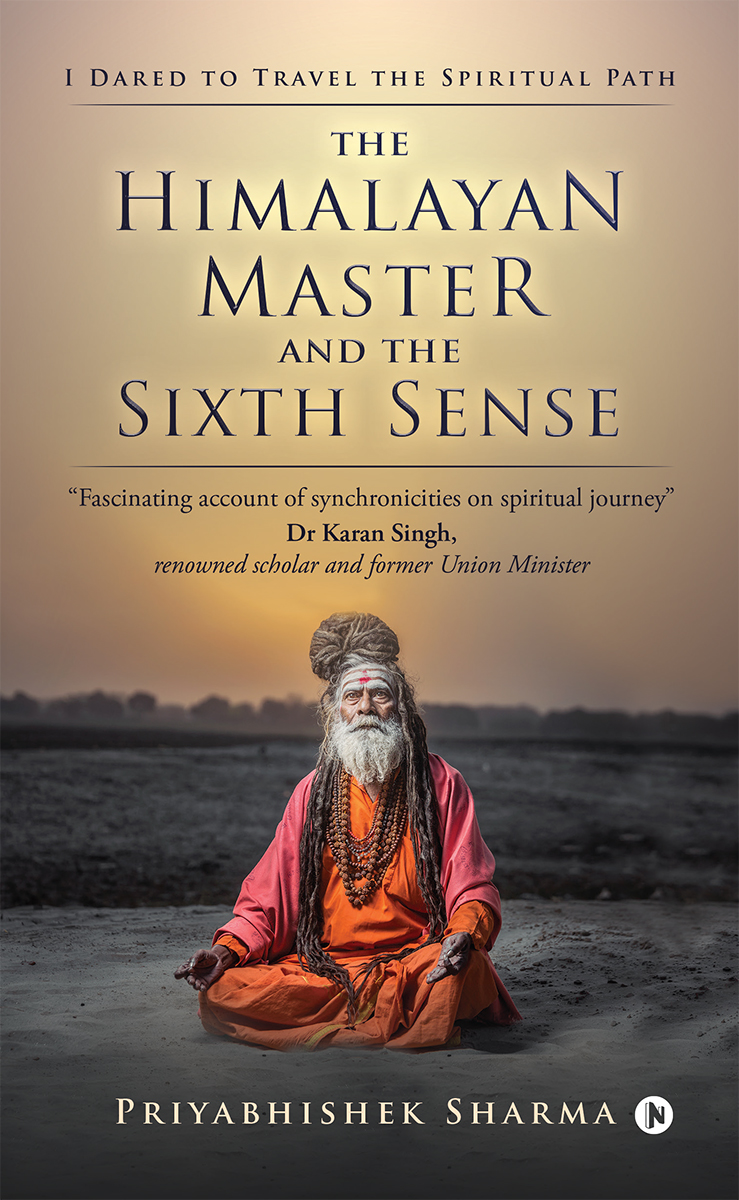
BODY, MIND & SPIRIT | 33 Chapters
Author: Priyabhishek Sharma
Priyabhishek Sharma’s account of his spiritual journey and the remarkable events and synchronicities therein is quite fascinating. I have read it with much interest and pleasure. Dr Karan Singh, renowned scholar and former Union Minister. Initiated by a Himalayan Yogi (ascetic) with a beej (Vedic seed) mantra (prayer or chant),....
Prologue
What is that, declares Mundako Upanishads, by knowing which everything else is known. The quest to know is human but the mode of knowing is individual. When this quest takes a turn to the inner self - naturally or triggered by an event - it becomes spirituality. This spiritual urge to know our true self is natural but to begin walking on the path of spirituality is incidental, which is to say that there has to be a reason to begin that walk. Eye contact with someone whom we meet may change the direction of our lives or an event in our life may lead us in the direction to seek wisdom and deeper meaning of life. And, we set on a voyage of seeking not fully understanding what is being sought. We just start walking towards a misty destination. That’s how it happened to me. I had set out to seek something not quite clear but the journey had begun.
Why would my story matter to you or your story matter to me unless it has something meaningful to contribute to our own curiosities towards the Unknown? I am not a monk; I am at best an enigmatic married family man, father to a son, a reluctant hedonist, and had many crushes in life - the greatest being for the civil services exam that lasted for a decade. I was also not born as a great soul with an innate longing for God to be embraced by an enlightened Master to be guided into realization. I was, and am, a person of contradictions who accidentally came to the world of seeking. This elusive search, which later on became a spiritual quest, began out of the logic of circumstances – let me avoid the word fate – rather than out of any natural craving. Thus beginning as an accidental seeker, my footsteps gradually got firmly ensconced as a traveler of the spiritual path as I kept walking. The blurred road, however, kept opening with every stride through an exciting excursion of interesting landmarks making my journey not less worthy a pursuit to have been trudged in life than having been met with some other priority.
An accidental meeting with a Himalayan Master and my pure ad hoc drills into meditation with the beej (Vedic seed) mantra (chant) enunciated by him changed the direction of my life when a couple of years later, one day, I awoke to a weird dream finding my mind connecting with far off places and people. This experience bewildered me but also permanently changed me – now I had become a student of my own mind having turned my elusive outside search to the inside. The real journey into the world of meditation began. Going thus on, sooner, I realized that I was a victim of as well as a captive to my own mind. For at every attempt to rise, my footsteps would be clasped down to fall. However, as I kept seeking my own mind through a newly learned scientific technique of mind management called Kriya Yoga Meditation, after initial turmoil and discomfort, it started falling into place with some degree of fine-tuning with me. As this friendship between me and my mind grew, I became acquainted with the enormous powers that a focused mind was able to bestow. It opened to me a massive inner world full of spiritual possibilities that I was not aware of. As my association with the mind and meditation grew there came on this journey the third M – Masters. Many Masters appeared on the path guiding me on the crossroads, some staying for a longer duration, others just disappearing after giving the important guidance. Now a fourth M had entered into my life called Miracles. The journey had become replete with so many coincidences for which a better word ‘miracle’ had to be used as you would understand walking along in the succeeding pages. Now I was not walking but just skidding through towards the destination.
How many times does it happen to every one of us that our instincts turn true, our premonitions caution us of impending danger that lies ahead in our path of life or incidents cast their shadows before an event? This is called intuition or sixth sense. Intuition just simply occurs as a flash of insight. It appears not from the thought of rationality or utility but from the gap that lies between two thoughts. It is a universal faculty of every creature. Animals are known to have this gift for centuries. Human beings also experience this faculty on many occasions. A mother, for instance, develops uncanny uneasiness for no known reason when at the same time her child at a faraway place is not feeling well. How many times it turns out that the friend we are thinking about instantly gives us a phone call. These might be those instances of coincidences in life, which happen on various occasions. But these might also be a reception of the vibration emitted by the close bond between two people. In the world of mobile phones, it is not unreasonable to believe that an intense thought can also travel through some kind of energy field from one person or place to another. In the current psychological lexicon, this faculty has been investigated as the extrasensory perception (ESP).
No other term has been more assiduously dabbled by the curious human quest since the earliest times than the mind has, yet it is an elusive term. More often in common parlance, it is commonly confused with the brain. Leaving aside the fierce debate, let’s say the mind is what each individual thinks, feels, wills, desires, and perceives. In other words, while the brain is an organ the mind is a process. Who gets what has been a domain of long debate between philosophers and scientists but for the well being of human life both are indispensable. Patanjali Yoga Sutra, on the other hand, defines yoga as ‘the cessation of the modifications of the mind’; the mind and its various modifications thus become extremely important to systematically proceed ahead on the eight-fold path eventually culminating into the Samadhi.
This book has emerged out of my almost two decades of exploration into the three Ms: Mind, Monks, and Meditation. On this quest, I was driven not by an anthropologist’s objectivity to discover some social and cultural process at work but a seeker’s curiosity to know, learn, and assimilate the pearls of wisdom worth the merit in my own life. The trained social scientist in me with a doctorate in Political Science has always worked to keep my assumptions, beliefs, and mode of seeking within the walls of reason. Simply put this has been a journey with my own conflicts – the conflicts we as individuals strive from the cradle to the grave to live up to and come clear of as better human beings. One chapter in this book ‘Meeting with the Himalayan Yogi’ is reproduced from my previous book ‘The UPSC Odyssey: Daring to Dream an IAS Officer’, for that meeting was a colossal event not only in my student life but also on my spiritual journey. So there was no point in rephrasing that. It was my wish to include in this book one photograph of the Master, at whose feet this journey eventually culminates, but his refusal of my request with a compassionate smile let that treasure safely remain in the canvas of my soul instead of in the pages of this book.
Chapter 1
Elusive Search
Lord Hanuman set afire and reduced Ravana’s impeccably guarded palace in Lanka to ashes the previous night. As an eight-year-old child, I had watched this folk drama re-enacting the life of Lord Rama staged in our village along with my two younger sisters. The next day we gathered at the back of our village home enthusiastically emulating the scene. A carefully chosen bamboo stick bent from the top resembling the tail of a monkey was fastened with rags and covered with a polythene bag. Inserting it in the back of my shorts, like a tail, I commanded my two sisters to pour a few drops of kerosene oil on the rags and light it. “Bhaiya (brother), what are you doing? Isn’t it risky with the possibility that you may catch fire?” My younger sister, who was also the wisest among the three of us, reasoned. “Don’t worry, I will take care of that,” I told her chanting a slogan like Lord Hanuman as seen the previous day. Thus my make-believe tail was lit and out I went running, jumping and screaming, trying to emulate Lord Hanuman.
I ran to the back of my house where a large bamboo tree stood for more than a decade. In autumn, dry leaves were spread all around on the ground. The polythene bag started leaking drops of burning kerosene on the ground, which I had not visualized in my plan. A few drops fell on the leaves and in an instant, the tree was up in flames. Immediately uprooting the tail and throwing it into the fire, I ran with my sisters and silently hid in a room in the house. Now the scare had set in. Two neighboring houses were in danger of being set afire. Opening the window, we nervously peeped outside, people were throwing buckets of water to douse the fire; some were using green branches to douse the flames. My mother and grandmother seemed to have smelt that this could be nobody else’s doing except their naughty son. As the reminiscences of that childhood episode take me back into the mirror of the past, I see reflections of the emerging traits of my early personality as a naughty and daring child with little insensitivity towards consequences.
Childhood was a phase to relish the innocence, curiosity, and bewilderment. The world was an exciting place happening in accordance with my own wishes. As a child, my world was no different from the other children of the village except for a few peculiar eccentricities, which kept me engaged in search of something not quite known. So it gave a mystifying touch to my extrovert nature. My parents were school teachers and my grandmother stayed with us. Her day began and ended with me.
As teenage dawned on me when I was in the seventh standard, a host of perceptible changes seemed to have taken place in how I was thinking about the world and myself. The perennial question that I unnecessarily pondered was what was I to do in life? The earlier childhood curiosity had stormed into an intriguing inquisitiveness about the purpose of life that seemed to be mystifying with every passing day. The endless questions directed at my parents earlier had taken a turn to a new protagonist, who had just unraveled from somewhere deep inside acting sometimes as the inquired and sometimes as the inquirer. The world with all its excitements and possibilities, and with all its vulnerabilities and ironies often failed to account for the mind of an eager adolescent who had by now even become rebellious and argumentative.
Having been born in a village situated in the Western Himalayas in Himachal Pradesh, two incidents of my childhood left a deep impression on my mind. On an all-India tour with my parents, we had gone to Kanyakumari (aka Cape Comorin), the southernmost tip of India. Boarding a ferry, we went across the sea to Vivekananda Rock. As a ten-year-old child, I was scared to see the violent sea waves advancing to the rock and getting ruthlessly dispersed. There was a magnificent structure constructed on a piece of rock surrounded by the sea, where once young Vivekananda had swum to meditate. My father was giving instructions to me and my two younger sisters before we entered a dome-shaped meditation hall.
“Dear children! Listen carefully. When we enter this room, be absolutely silent.”
“Papa, what is this room about? What will we do inside if not talking?” My questions used to be endlessly irritating to my parents. My innocent mother would direct me with those questions to my father, who always paid the utmost attention carefully listening to them and giving me an encouraging pat for having asked those questions.
“This is a meditation room. In it, we go and sit silently with our eyes closed.” As father tried to explain to us, we hardly understood what he was saying wondering what would one do with the eyes closed and not listening to anything.
“Do you really want to go inside?” Realizing we were yet too young to be carried inside, finally, it was decided that I would go inside and my two younger sisters would stay back with our grandmother.
I reluctantly entered the meditation room. As I slowly made my way behind my father, there was complete darkness. After a while, the dark interiors became hazily visible bathed in a soft glow. I sat in a corner and looking around, I recognized some people sitting with their eyes closed. I also closed my eyes and tried to stop the flow of thoughts. For the first few minutes, the young mind wandered frantically but after a while, it started settling down. As I persisted with this state of mind for a few seconds I felt myself losing contact with the body, dissolving like a heap of soil in the whirling water. “Oh! My God, what is happening,” without losing any more time, with a jerk of bewilderment, I immediately opened my eyes and felt greatly relieved to regain the awareness of my body. Remaining seated at the occupied place for few more minutes but with the eyes widely opened, the silence initially appearing to be elusive now looked mysteriously attractive. It had a soothing effect on my mind as is felt when listening to classical music. Absorbed in a new unrealized conversation with the silence for the first time, I seemed to have lost the instinct to quickly come out of the darkroom. A gentle rub of a hand on my back brought me out of my trance and it was an indication from my father to leave the meditation hall. The impressions of that experience lasted for about fifteen minutes and created an underneath sense of curiosity towards what remained behind the thoughts for later life.
Exactly similar feelings took place four years later at the Lotus Temple in New Delhi. This time we had been on another all-India tour and were visiting tourist places in Delhi. As we were silently accorded into the circular prayer hall of Lotus Temple, there was pin-drop silence inside. I felt myself withering away with the music of silence. For a moment the whirlwind of my mind subdued. From underneath appeared something very appealing, very soothing but equally mysterious. Now I was more grown-up to feel and appreciate the value of that experience, which I had not felt in the outer world of activities. As I witnessed my thoughts gradually disappearing with the cleansing ebb of golden silence, I realized no other activity since my recallable childhood, whether playing with friends, eating sweets, watching Jungle Book Cartoon on television, or visiting new places, had given me such a feeling of joy and internal fulfillment. Walking through the captivating surroundings of the premises of the Lotus Temple laced with long lush green spiral lawns and colorful flowers, I had hardly expected that the best part of that visit was going to be inside the four walls of a pillarless prayer hall.
I had a very receptive and thus also very vulnerable mind. It was greatly influenced by the surroundings. But it also had a blend of stubbornness. It was a routine day of our tuition class of mathematics. As usual, we had gone to the neighboring village on a January afternoon. Unlike the other days, the tuition class had stretched well over an hour and a half because the respected teacher didn’t want to leave the topic unfinished. In the Himalayas, dusks in winter were short-lived and the twilight crimson receded faster into the night’s darkness. There used to be a rivulet with a wide stretch on the way, which we had to cross to reach our village. We had grown up listening to ghost stories of that rivulet in the decades of the late 1980s and early 1990s. We were a group of five students and moving together as a group was not an issue.
Despite the assumed steadfastness of newly grown-up teenagers, we were scared underneath to cross the dreary rivulet. Sunil, the most acrobatic built among us and a sportsman of reasonable merit, threw a naughty challenge asking if any of us had the guts to walk alone across the rivulet to our native village. He knew full well as did others that nobody was going to attempt that insanity because of the strong conditioning of fear that dissuaded even an adult to walk alone across that rivulet at night. Keeping away from unnecessary involvement and mostly remaining confined to a modest setting of my own, challenges always got me going, pushing me out of my comfort zone to test if I could overcome fears and limitations. The challenge of the childhood companion had irresistible merit to be overlooked.
Instead of verbally accepting the challenge, I picked up speed and with the brisk strides began to generate a fair gap from my following companions. Realizing that I had accepted the challenge, my friends deliberately halted for a while intending to create a wider gap that would deprive me of the encouragement of a close following company. Covering a fair distance, I reached the flowing water of the rivulet. There was no bridge on the road and pedestrians and vehicles had to move across the flowing water.
As I reached the middle of the rivulet jumping over stones protruding over the water as a kind of a bridge for pedestrians, I felt a nerve-wrenching fear pressing me to run fast to avoid any nasty chase by someone from behind. But running ahead was in no way a relief because the road would pass through a more-dreadful-kilometer-long-terrain beside the river bed. A retreat was the safer choice but not the nature I was characteristically endowed with - before that day as I recall to this day or after that day. The path once chosen, good or bad, was as a principle to be traversed till the end and easier paths didn’t quite fancy my imagination. For quite some time, I observed myself in a dialectic dialogue with a protagonist inside but as I was crossing the rivulet the dialogue became a swirl between fear and steadfastness. While an impulse was pressing hard to run fast and escape from fear, a reason persuaded me to stay firm with the logic that all ghost stories were fables of human fancy. I was scared but I was undeterred. I didn’t know if ghosts existed but I was ready to confront them head-on if they really did.
Holding on to my nerves I kept walking. It was so dark that the surroundings were dimly visible. The sounds of beetle and grasshoppers didn’t sound pleasant to the ears when the mind was already grappling with fear. The minutest of the movement or sound around the path or in the bushes caused a ripple of Goosebumps and alertness in me. I kept walking reminding myself at every scary thought that no matter what I would accomplish the journey. Having covered half the distance, I turned and looked behind at the horizon to find if my companions were following; and felt slightly dejected not to find any trace of them as they had deliberately slowed down to complicate my challenge. But I had already traveled a fair distance and realized that having walked on a consciously chosen path for a substantial distance, I was not left with many options in life except to keep moving ahead. By now the initial nervousness of being alone on the dreary road had also somewhat subsided into an enthusiasm of having almost reached the destination.
BODY, MIND & SPIRIT | 33 Chapters
Author: Priyabhishek Sharma
Support the author, spread word about the book to continue reading for free.
The Himalayan Master and the Sixth Sense





Comments {{ insta_features.post_zero_count(insta_features.post_comment_total_count) }} / {{reader.chap_title_only}}
{{ (txt.comment_text.length >= 250 ) ? txt.comment_text.substring(0,250) + '.....' : txt.comment_text; }} Read More
{{ txt.comment_text }}
{{txt.timetag}} {{(txt.comment_like_count>0)? txt.comment_like_count : '' }}{{x1.username}} : {{ (x1.comment_text.length >= 250 ) ? x1.comment_text.substring(0,250) + '.....' : x1.comment_text; }} Read More
{{x1.comment_text}}
{{x1.timetag}} {{(x1.comment_like_count>0)? x1.comment_like_count :''}}{{x2.username}} : {{ (x2.comment_text.length >= 250 ) ? x2.comment_text.substring(0,250) + '.....' : x2.comment_text; }} Read More
{{x2.comment_text}}
{{x2.timetag}} {{(x2.comment_like_count>0)?x2.comment_like_count:''}}